
Why most businesses don’t scale (and what holds them back)
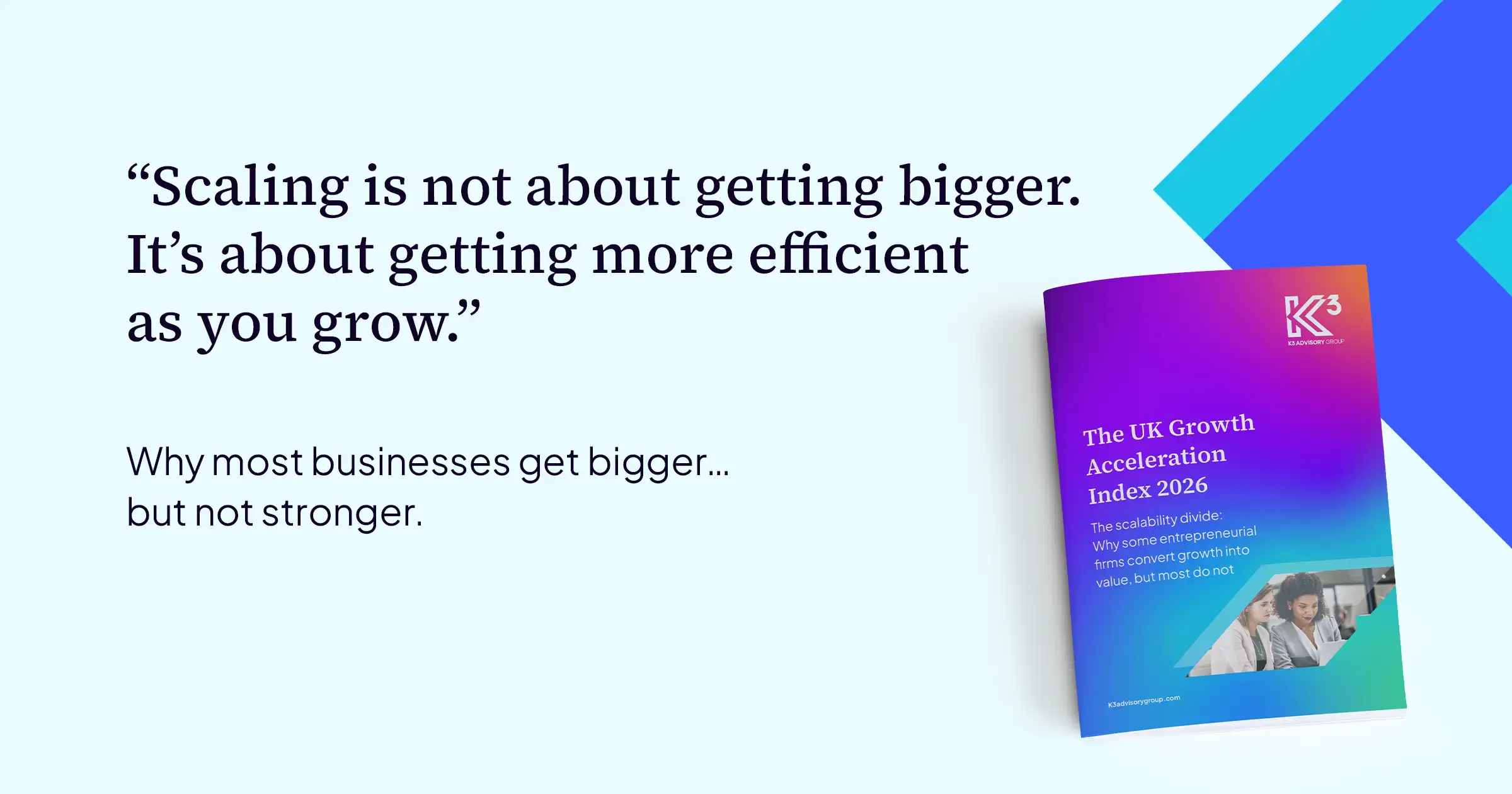
The UK does not have a growth problem. It has a scalability problem.
Across the market, many businesses are expanding. Revenues are increasing. Teams are growing. New opportunities are being pursued. On the surface, it looks like a strong environment for ambitious companies.
But growth alone is not the same as scaling a business effectively.
Many UK businesses are growing. Far fewer are building organisations that can carry growth in a way that creates long-term value. Understanding that gap is critical.
Growth is visible, scale is structural
Consider a typical scenario. A £10m business doubles revenue over three years. Headcount grows even faster. Margins tighten. Cash becomes harder to manage. Leadership spends more time solving problems than planning ahead.
From the outside, it looks like success. Inside, the business feels more complex, more fragile and harder to run. This is the difference between growth and scale.
Growth means increasing revenue, often alongside a proportional increase in cost. More sales require more people, more infrastructure and more capital.
Scalability in a business means increasing revenue without a proportional increase in cost or operational complexity.
Many businesses achieve growth. Far fewer achieve scale. Our recent analysis of more than 134,000 UK businesses highlights a consistent pattern. Growth is common, but only a small proportion of companies are structurally built to carry that growth in a way that creates long-term value. Most sit somewhere in between. They are growing, but with underlying pressure building inside the business.
Why businesses struggle to scale
So, why do so many businesses struggle to scale effectively? In our experience, the issue is not ambition. It is alignment.
“Many businesses reach a point where growth starts to feel harder than it should. That is usually when the business has outgrown its structure but has not rebuilt it.” says Ian Barton, Corporate Finance Adviser at K3 Advisory Group.
There are three areas this typically shows up:
1. Revenue is growing but not repeatable
Growth can mask volatility. Revenue may increase year on year, but if that growth is driven by one-off projects, a small number of key clients or inconsistent sales performance, it becomes difficult to forecast and sustain. From a distance, the business looks like it is scaling. In reality, it is rebuilding revenue every year. This is where investors and lenders take a different view. They look beyond headline growth and into the quality and predictability of earnings. Without that consistency, confidence falls and options narrow.
2. Cost and complexity grow faster than performance
In many businesses, revenue growth is matched, or exceeded, by rising complexity. Headcount increases, processes become layered and costs expand. A company might grow revenue by 30% but increase its cost base by even more. Margins compress and operational strain builds. At that point, growth stops creating value. It starts absorbing it. Businesses that scale effectively do something different. They increase output without a proportional increase in cost. Productivity improves. Systems carry more weight. Decision-making becomes clearer, not slower.
“Scaling is not about getting bigger,” adds Ian Barton. “It is about getting more efficient as you grow. Many businesses end up scaling cost rather than performance.”
3. Growth puts pressure on cash and capital
Growth often changes a business’s financial profile, but not always in a controlled way. Cash becomes tighter. Working capital requirements increase. Debt is introduced or expanded without a clear long-term plan. Funding capacity is not fully understood until it becomes a constraint. The result is a business that is larger, but less able to act or scale with confidence. Opportunities become harder to pursue. Challenges become harder to absorb. Strategic options narrow at the point they should be expanding.
Taken together, these factors explain why so many companies struggle to convert growth into value.
“Scaling is not about doing more of the same, faster,” adds Ian. “It’s about building a business that can support growth without becoming harder to run, harder to fund or harder to sell.”
What this means for leadership teams
The most important question is no longer whether the business is growing. It is whether it is built to scale.
That means focusing on the structural drivers of performance:
These are not theoretical questions. They shape valuation, funding access and long-term outcomes.
In many cases, signals appear early. Margins tightening despite growth. Cash becoming harder to manage. Leadership time shifting from strategy to problem-solving. These are not just growing pains but signs the business may not be scaling effectively.
At K3 Advisory Group, we work with entrepreneurs, leadership teams and their advisers at these moments of growth, change and transition. Often, the most valuable work happens before issues become visible.
The businesses that scale successfully are not necessarily the fastest growing. They are the ones built to carry growth without letting it make the business harder to run, harder to fund or harder to sell.
Growth shows what is possible. Scale determines what is sustainable.
To explore the findings and understand what drives scalable growth, download the full UK Growth Acceleration Index report here.
Subscribe to newsletters
Share article
Follow K3 Advisory Group



