
Why some growing businesses become less valuable
Growth is often treated as proof that a business is becoming stronger.
Revenue rises, new customers arrive and headcount expands. From the outside, momentum appears positive. Yet growth alone says very little about whether a company is actually becoming more valuable.
Across the UK mid-market, many businesses are discovering that scaling revenue and building enterprise value are not the same thing. Some firms become more profitable, more efficient and easier to scale as they grow. Others experience the opposite: margins tighten, complexity increases and cash becomes harder to manage, even while sales continue to rise.
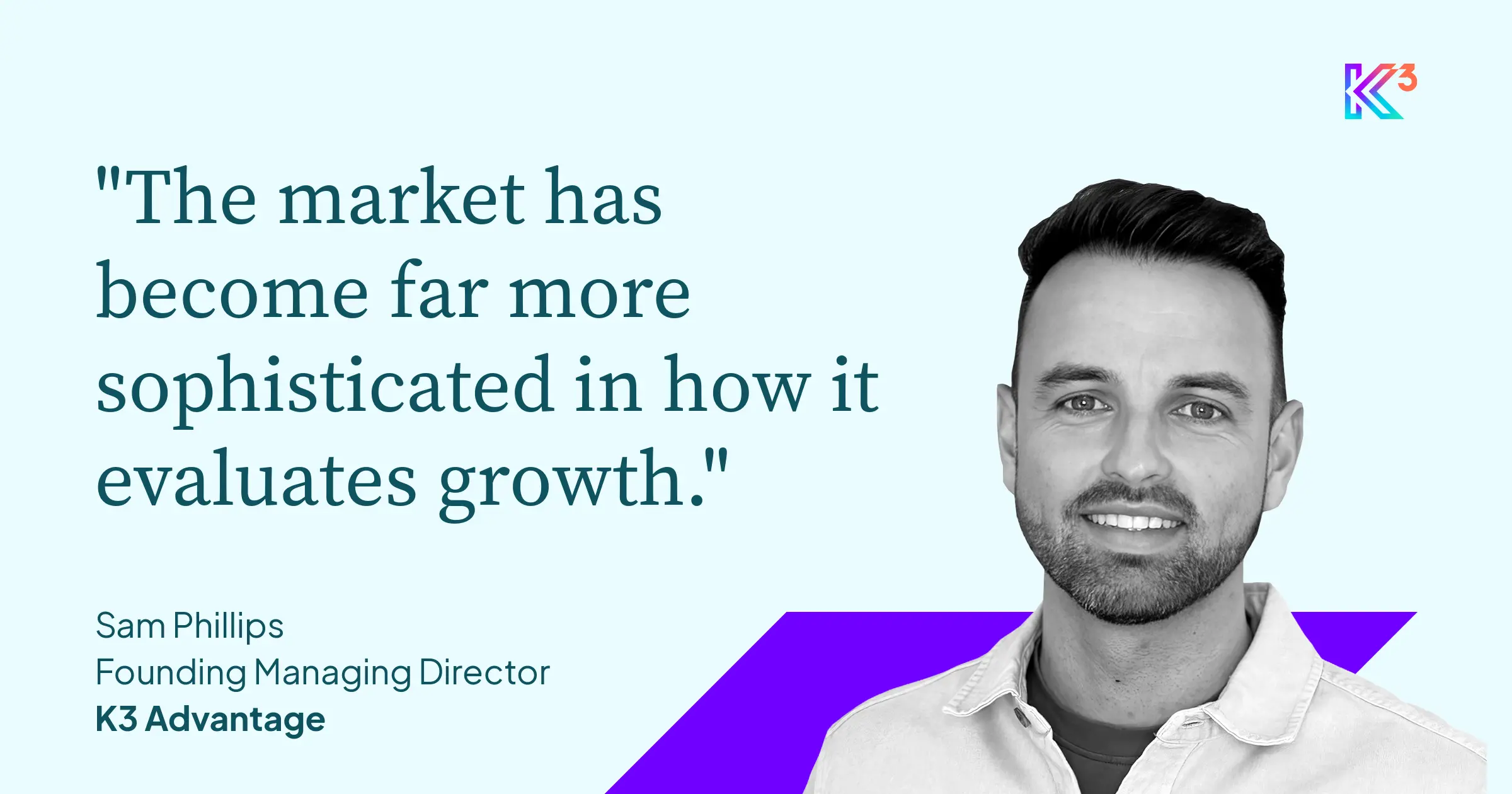
The difference is rarely visible in headline growth figures. Our analysis of more than 134,000 UK businesses for the UK Growth Acceleration Index suggests that one of the defining characteristics of higher-value businesses is their ability to grow without proportionally increasing operational strain. As Sam Phillips, Founding Managing Director at K3 Advantage, explains:
“The market has become far more sophisticated in how it evaluates growth. Investors are no longer rewarding revenue expansion alone. They are looking for businesses that can scale while improving efficiency, cash generation and operational control.”
Growth can improve scale economics or weaken them
Two businesses may report similar revenue growth over a three-year period while producing very different economic outcomes.
One may improve pricing power, automate processes and increase revenue per employee as it expands. The other may rely on additional headcount, tighter working capital and increasingly manual operational processes simply to maintain growth. Both businesses appear healthy when viewed through topline performance alone. But over time, the gap in underlying business quality becomes significant.
This distinction becomes particularly important during investment, refinancing or transaction processes. Buyers and lenders increasingly focus on the efficiency of growth rather than growth in isolation. They want to understand:
Businesses that scale efficiently tend to create more strategic flexibility. Businesses that grow through operational stretch often become harder to finance, harder to manage and ultimately harder to value confidently.
Productivity is one of the clearest indicators of scalable growth
One of the strongest signals in the data was the difference in productivity between scale-ready firms and structurally fragile businesses. Median revenue per employee reached approximately £322,000 among scale-ready firms, compared with around £48,000 in more fragile businesses.
That gap reflects more than sector variation. It often indicates fundamentally different operating models. Higher-performing firms typically use systems, data visibility and process discipline to increase output without increasing cost at the same rate. Growth becomes increasingly efficient over time.
Lower-productivity businesses often experience the reverse. As demand increases, complexity rises faster than operational capability. More people are added to solve problems manually, reporting becomes less reliable and leadership teams spend more time managing friction.
In these situations, revenue growth can actually reduce the quality of the business if the underlying operating model is not evolving at the same pace.
Cash strength creates strategic freedom
The research also highlighted a major difference in balance sheet strength. Three quarters of scale-ready firms operated in a net cash position, compared with only 45% of structurally fragile businesses. This matters because financially resilient businesses retain optionality.
They can invest earlier, respond faster and make decisions from a position of control rather than pressure. Growth becomes easier to sustain when businesses are not constantly balancing expansion against liquidity constraints.
By contrast, weaker cash generation often forces leadership teams into reactive decision-making. Investment gets delayed. Hiring becomes inconsistent. Operational issues consume more management attention. Over time, growth starts absorbing capacity instead of creating value.
Visibility becomes harder as businesses scale
One of the most consistent themes across growing firms is that complexity tends to increase faster than visibility. As businesses expand, financial data, operational reporting and commercial information often become fragmented across multiple systems. Leadership teams may still have access to large amounts of information and connecting it into a clear operational picture becomes increasingly difficult.
This is often the point where early warning signs begin to get missed. Margins start drifting. Forecast accuracy deteriorates. Working capital pressure builds gradually rather than suddenly. Teams compensate operationally before problems appear financially. According to Sam Phillips, who advises leadership teams on scaling performance and operational visibility:
“Most leadership teams do not realise scalability is deteriorating until performance starts becoming inconsistent. By that stage, margins, forecasting accuracy and decision-making discipline have usually been under pressure for some time.”
That is one of the reasons K3 Advantage, part of K3 Advisory Group, developed Advantage IQ, a decision intelligence platform designed to bring financial and operational information into a single decision-ready view. By improving visibility across performance drivers, businesses are often able to identify pressure earlier, improve forecasting confidence and make better scaling decisions before inefficiencies become embedded.
Sustainable value creation depends on how businesses scale
For leadership teams, the challenge is no longer simply achieving growth. The more important question is whether the business becomes stronger as it expands.
The businesses creating long-term value are usually the ones that scale through efficiency, clarity and operational discipline rather than continual resource expansion.
At K3 Advisory Group, we work with businesses during periods of growth, transition and strategic change. The strongest outcomes typically come from aligning operational capability, financial structure and commercial strategy early enough that growth compounds value instead of introducing friction. Because ultimately, sustainable growth is not defined by how quickly a business expands. It is defined by whether the business becomes more efficient, more resilient and more scalable as it grows.
To explore the full findings from the UK Growth Acceleration Index, including the operational, financial and productivity characteristics that separate scale-ready firms from structurally fragile businesses, download the full report here.
The report analyses more than 134,000 UK businesses and identifies the patterns most closely associated with scalable, value-creating growth.
Subscribe to newsletters
Share article
Follow K3 Advisory Group



